


Get a Quote

+86-18862679789


admin@evertopest.com

Content
A complete panel production line rarely stands or falls on its main press or laminating unit alone. In practice, the auxiliary equipment for panel production line setups — leveling machines, delamination units, lifting platforms, coaters, dry mixers, calenders, T-dies, and auto filter exchangers — is what determines whether raw aluminum coil, mineral core material, and film actually turn into flat, consistent, sellable metal composite panels. A production line built only around a central forming unit, without matched auxiliary equipment for panel production line workflows on either side of it, tends to bottleneck at feeding, leveling, or finishing stages, even when the core press itself is capable of high output. This article explains what auxiliary equipment a panel production line typically requires, how each machine contributes to line performance, what industry data shows about demand for aluminum and fire-resistant composite panels, and how a manufacturer or project team can evaluate auxiliary equipment before committing to a production line layout. The goal is to give production managers, procurement teams, and panel manufacturers a practical reference they can use when comparing equipment options, rather than a general overview that stops short of the specific machines involved. Readers looking for a quick answer will find it in the sections that follow: auxiliary equipment for panel production line setups typically spans material preparation, forming and leveling, coating, extrusion support, and material handling, and each of these functional groups is covered in turn below, supported by industry data, comparison charts, and a labeled equipment schematic.
A panel production line for metal composite panels, aluminum composite panels (ACP), and aluminum honeycomb composite panels is generally organized into three functional groups: material preparation equipment, forming and bonding equipment, and finishing or handling equipment. Auxiliary equipment for panel production line configurations sits across all three groups rather than in a single position, which is why buyers sometimes underestimate how many supporting machines a complete line actually needs. A three roller leveling machine, for example, corrects coil curvature before the material enters a laminating or coating stage, while a calender machine compresses and smooths composite sheet after bonding. A dry mixer prepares core material such as mineral powder or polyethylene compound before it is extruded or laminated, and a T-die shapes molten core material into a continuous flat sheet during extrusion-based core production. A coater applies protective or decorative coatings such as PVDF or polyester film to the aluminum skin, an ACP delamination machine separates bonded layers for quality testing or recycling processes, a lifting platform supports safe vertical material handling between stages, and an auto filter exchanger keeps molten polymer streams clean during continuous extrusion without stopping the line. Understanding how these machines relate to one another is the first step toward specifying a workable, well-balanced panel production line.
| Equipment | Primary Function | Typical Line Position |
|---|---|---|
| Three Roller Leveling Machine | Corrects coil curvature and internal stress in aluminum sheet | Before bonding or coating |
| ACP Delamination Machine | Separates bonded skin and core layers for QC or reprocessing | Post-production testing area |
| Lifting Platform | Raises and positions coil, sheet, or panel loads safely | Material handling zones |
| Coater | Applies protective or decorative surface coating to aluminum | Coil pretreatment stage |
| Dry Mixer | Blends core compound before extrusion or lamination | Core material preparation |
| Calender Machine | Compresses and smooths sheet thickness after bonding | Post-lamination finishing |
| T-die | Shapes molten core compound into continuous flat sheet | Extrusion stage |
| Auto Filter Exchanger | Removes contaminants from molten polymer without stopping the line | Continuous extrusion stage |
It is worth noting that not every panel production line uses all eight categories listed above. A line dedicated to laminated composite panels using pre-coated aluminum coil, for instance, may not require a coater of its own, while a line built purely around extrusion-based core production will place more emphasis on the T-die and auto filter exchanger than on the ACP delamination machine, which is more commonly used for quality testing and reprocessing rather than routine forming. What remains consistent across most configurations is the underlying logic that material preparation equipment must feed forming equipment at a matched rate, and forming equipment must in turn feed finishing and handling equipment without creating backups at either end of the line. Manufacturers and wholesalers planning a new panel production line, or evaluating equipment for panel production line upgrades, generally start by mapping their intended product mix against this equipment list, since the target panel type ultimately determines which auxiliary machines are essential and which can be added later as production volume grows.
Before looking at individual auxiliary machines, it helps to understand where global demand for aluminum composite panels is concentrated, because that demand ultimately shapes how much supporting equipment a panel production line operator needs to install. Regional demand is not evenly distributed, and construction activity in fast-growing regions places different pressure on production capacity than mature, replacement-driven markets. A production line destined for high-volume export markets is generally specified with more redundancy in auxiliary equipment, such as a second lifting platform or an additional auto filter exchanger, than a line built mainly for smaller domestic orders. The chart below breaks down where aluminum composite panel revenue is currently concentrated on a regional basis, using published market research as a reference point rather than an internally generated estimate.
According to Grand View Research, Asia Pacific accounted for 40.8% of global aluminum composite panel revenue in 2024, the largest single regional share, followed by North America at 26.8%, with the remaining roughly 32.4% spread across Europe and other regions combined. This distribution matters for anyone specifying auxiliary equipment for panel production line projects, because a facility supplying the Asia Pacific market is typically expected to run at higher continuous throughput and therefore benefits from auxiliary equipment configured for minimal downtime, such as an auto filter exchanger that permits filter changes without halting extrusion. The same GVR data shows the construction segment holding roughly 54% of total ACP application revenue in 2024, which means a large share of the demand behind this regional split is tied to façade, cladding, ceiling, and wall panel projects rather than smaller signage or transportation applications. Facilities serving construction-grade demand generally need consistent leveling and calendering performance, since façade panels are visually inspected at close range and any waviness or thickness variation is far more noticeable than it would be on a panel used for temporary signage. A three roller leveling machine positioned ahead of the bonding stage directly addresses this requirement by reducing coil memory and surface waviness before the aluminum skin reaches the laminator. Coaters and calenders positioned later in the line then reinforce this consistency by applying uniform surface finish and controlling final sheet thickness within a narrow tolerance band. For manufacturers evaluating where to invest first, this regional and application data suggests that leveling, coating, and calendering equipment deserve early attention, since they most directly affect the finish quality that construction-grade buyers scrutinize. It also explains why many manufacturers treat auxiliary equipment for panel production line planning as a core part of line design, not as a secondary purchase decided after the main press or laminator is already selected. Manufacturers and wholesalers supplying export markets in particular tend to prioritize auxiliary equipment that reduces unplanned downtime, since shipping delays caused by line stoppages are more costly on long international routes than on shorter domestic ones.
Regional share is only part of the picture; the pace at which the overall aluminum composite panel market is expected to grow also matters when a manufacturer decides how much auxiliary equipment capacity to build into a new panel production line. A market expanding steadily over several years generally justifies investing in higher-capacity auxiliary equipment for panel production line operations upfront, rather than adding capacity in smaller increments later, since retrofitting a running line is usually more disruptive than specifying adequate capacity from the start. The chart below traces the projected growth of the global aluminum composite panel market from 2024 through 2030, based on a compound annual growth rate published by Grand View Research. It is presented as an estimated trajectory rather than a guaranteed outcome, since actual year-to-year results depend on construction cycles, regional regulation, and raw material availability.
Grand View Research estimated the global aluminum composite panel market at approximately USD 6.47 billion in 2024 and projected it would reach USD 9.65 billion by 2030, reflecting a compound annual growth rate of about 7.0% across the 2025 to 2030 period. That level of sustained growth is meaningful for any manufacturer weighing whether to add a second production line or expand supplementary equipment capacity on an existing panel production line, because it implies steady order growth rather than a short-term spike that would not justify permanent capital investment. A market growing at roughly seven percent annually also tends to reward manufacturers who can maintain consistent output quality at scale, which puts renewed emphasis on auxiliary machines that reduce variation between batches, including dry mixers that maintain consistent core compound blending and calenders that hold thickness tolerance across long production runs. The same research also noted that the PVDF coating segment was the largest product segment in 2024, pointing to continued demand for coating equipment capable of applying durable, weather-resistant finishes rather than lower-cost alternatives. For a manufacturer or trading company evaluating a new panel production line, this growth trajectory supports specifying auxiliary equipment with some built-in headroom above current order volumes, since equipment that is only just adequate for today's throughput can become a bottleneck within two or three years if the underlying market grows as projected. It is worth noting that this projection reflects an industry-wide trend rather than a guarantee for any individual manufacturer, and actual results will vary by region, product mix, and customer base. Even with that caveat, the consistency of the growth estimate across multiple years gives production planners a reasonable basis for phased auxiliary equipment upgrades rather than reactive, one-off purchases made only after a bottleneck appears.
Not every piece of auxiliary equipment for panel production line operations plays the same role, and grouping machines by their operating characteristics helps clarify why a line needs several different types rather than one universal solution. Forming-stage equipment, such as the three roller leveling machine and the calender machine, is generally judged on output consistency and throughput capacity, since its job is to physically shape and correct material at line speed. Material handling equipment, such as the lifting platform, tends to be judged more on integration ease and maintenance simplicity, since its primary function is supporting safe movement rather than actively processing material. Coating and mixing equipment sits between these two groups, contributing to both product finish and upstream material consistency. The radar chart below compares three broad equipment groups across five operating characteristics on a relative one-to-five scale, intended purely as an illustrative comparison to support planning discussions rather than as a formal benchmarking study.
The radar comparison illustrates a pattern that production engineers generally recognize in practice: forming-stage equipment such as a three roller leveling machine or calender machine tends to score highest on throughput capacity and finish sensitivity, since these machines directly shape or correct the material that customers will later inspect visually. Coating and mixing equipment, including coaters and dry mixers, typically scores well on output consistency, because their primary contribution is repeatable, uniform material preparation rather than raw speed. Handling equipment such as a lifting platform tends to score highest on integration ease and maintenance simplicity, reflecting the fact that its mechanical design is generally simpler than forming or coating machinery, even though its role in preventing workplace injury and material damage is just as important operationally. Automation level varies across all three groups depending on how a specific line is configured, with newer panel line auxiliary machinery installations increasingly including programmable logic control for roller gap adjustment, coating thickness, and mixing cycle timing. None of these characteristics should be read as a ranking of importance, since a production line cannot function correctly if any one group is missing or undersized relative to the others; a fast forming stage feeding into an undersized handling system, for example, simply shifts the bottleneck downstream rather than resolving it. This is one reason experienced production planners specify auxiliary equipment as a coordinated system rather than purchasing machines individually based on price or lead time alone. A calender machine with excellent output consistency provides little benefit if the upstream dry mixer cannot maintain consistent core compound density, since inconsistent core material will show up as variation later in the line regardless of how well the calender performs. Similarly, an efficient T-die extrusion setup can be undermined by a lifting platform that is too slow or too small to keep pace with continuous sheet output, creating unnecessary work-in-progress inventory on the shop floor. Reviewing equipment groups side by side in this way, rather than machine by machine, tends to surface these interdependencies earlier in the planning process, when adjustments are far less costly than after installation.
Fire performance has become one of the strongest drivers of new panel production line investment over the past several years, and this shift has direct consequences for the type of auxiliary equipment for panel production line operations a manufacturer needs. A2-grade and B1-grade fire-resistant composite panels use mineral-filled or non-combustible core materials that behave differently during mixing, extrusion, and lamination compared with standard polyethylene core panels, which means dry mixers, T-dies, and calenders on fire-resistant lines are often specified with different tolerances than those on standard lines. The gauge chart below shows the reported growth rate for the A2 fire-rated composite panel segment, based on published industry research, to illustrate how quickly demand for this panel category is expanding relative to the broader composite panel market discussed earlier in this article.
Published industry research puts the global A2 fire-rated composite panel market at approximately USD 2.6 billion in 2024, with projected growth to around USD 5.1 billion by 2033, representing a compound annual growth rate of roughly 8.1%, which is faster than the broader aluminum composite panel market growth rate discussed earlier in this article. That gap matters operationally, because it suggests fire-resistant panel demand is growing disproportionately, driven largely by stricter building codes and high-rise construction safety requirements rather than general construction volume alone. For a manufacturer already producing standard-core panels, this trend often translates into a decision about whether to add or upgrade supporting production line equipment specifically for fire-resistant products, rather than assuming existing equipment can be shared without modification. Mineral-filled core compounds used in A2 and B1 panels are typically denser and more abrasive than standard polyethylene compounds, which places additional demand on dry mixer blending consistency and can accelerate wear on T-die components if the equipment was not designed with these materials in mind. Calender machines processing fire-resistant panels often require finer thickness control as well, since mineral core panels are frequently specified for high-rise façade applications where visual consistency across large wall areas is closely inspected during project handover. Building and construction applications continue to represent the dominant end use for A2 fire-rated panels, accounting for a substantial majority of segment revenue according to available industry data, which reinforces the connection between this growth trend and the construction-driven regional demand pattern described earlier in the regional revenue chart. Auto filter exchangers also take on added importance on fire-resistant lines, since mineral-filled compounds are more likely to generate particulate contamination during continuous extrusion than standard core material, and an exchanger that allows filter changes without stopping the line helps maintain output quality without sacrificing throughput. Manufacturers evaluating whether to expand into fire-resistant panel production should weigh this faster growth rate against the additional equipment considerations it introduces, since the segment's expansion appears to be structural, tied to regulation and safety standards, rather than a short-term trend likely to reverse.
Because the three roller leveling machine is one of the most commonly specified pieces of auxiliary equipment for panel production line setups, it is useful to look at its structure in more detail. The schematic diagram below shows a simplified axonometric view of a typical three roller leveling machine, with major components labeled for reference. This type of machine works by passing aluminum coil through a set of precisely positioned rollers that apply controlled bending force in alternating directions, which relieves internal stress and flattens coil memory before the material reaches downstream bonding or coating equipment.
As the diagram shows, aluminum coil enters the machine along the feed direction and passes between upper and lower sets of leveling rollers arranged in a staggered configuration, which is the mechanical principle that distinguishes a leveling machine from a simple flattening roller. The adjustment screw controls the vertical gap between roller sets, allowing an operator to fine-tune bending force according to material thickness and temper, since thicker or harder-temper aluminum requires a different roller gap than thin, soft-temper coil. The base frame anchors the entire roller assembly and absorbs the mechanical load generated as coil passes through under tension, which is why frame rigidity is as important to leveling quality as roller precision itself. A drive motor, positioned at the base of the machine in this schematic, powers the roller rotation and is typically matched to line speed elsewhere in the production line so that leveling does not become a pacing bottleneck. Once material passes through the final roller set, it exits at the discharge end in a flattened state, ready to proceed to the next stage of the production line, whether that is a bonding press, a coater, or intermediate storage. This structural overview is intended as a general reference for understanding how leveling equipment fits into a broader panel production line rather than as a detailed engineering specification for any single model, since exact roller counts, diameters, and drive configurations vary between manufacturers and applications.
The equipment shown below reflects the type of auxiliary equipment for panel production line ranges that a metal composite panel manufacturer typically evaluates when planning or upgrading a production line, spanning material preparation, forming, coating, and handling functions. Having these categories available from a single equipment source can simplify coordination between machines, since forming, coating, and handling equipment designed to work together tends to integrate more smoothly than equipment sourced from multiple unrelated suppliers with different control interfaces and mechanical tolerances.
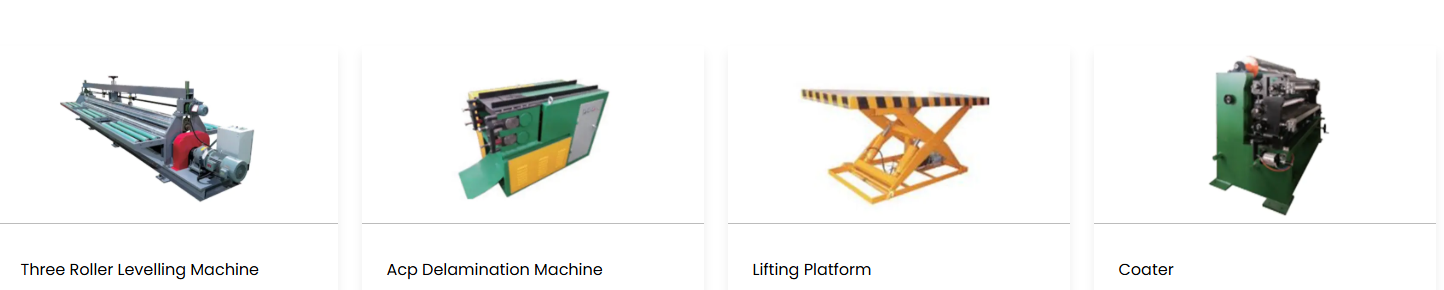

Representative auxiliary equipment categories for metal composite panel production lines.
Looking across this equipment range, a clear workflow logic emerges: the dry mixer and calender machine handle material preparation and finishing consistency, the three roller leveling machine and coater address surface quality on the aluminum skin, the T-die and auto filter exchanger support continuous core extrusion, and the lifting platform provides the material handling backbone connecting each stage. For a manufacturer or trading company sourcing equipment for a new line, reviewing this full range together, rather than specifying each machine in isolation, generally makes it easier to confirm that throughput rates, control interfaces, and physical footprints are compatible before installation begins. Buyers comparing production line suppliers often find it useful to request this kind of full-range equipment overview early in the procurement process, since it reveals gaps in a supplier's offering, such as a manufacturer that produces forming equipment but not compatible handling equipment, before those gaps become a problem during installation and commissioning.
Selecting auxiliary equipment for panel production line projects generally works best as a structured process rather than a series of ad hoc purchases, since each machine's specification depends partly on decisions made about neighboring equipment. The following factors are commonly used by production planners and equipment manufacturers to evaluate auxiliary equipment options before finalizing a line layout.
Manufacturers who work through this sequence before requesting quotations generally find it easier to compare supporting production line machinery options on a like-for-like basis, since each supplier's proposal can be evaluated against the same throughput, material, and integration requirements rather than compared on isolated technical specifications alone. It also reduces the likelihood of discovering a mismatch after installation, when adjustments are considerably more expensive than they would have been during the planning stage.
| Equipment Category | Key Evaluation Question |
|---|---|
| Leveling & Calendering | Can roller gap be adjusted precisely enough for the thinnest and thickest material planned for the line? |
| Coating & Mixing | Does the equipment maintain consistent output across long, continuous production runs? |
| Extrusion (T-die & Filter Exchanger) | Can filters be changed and die parameters adjusted without a full production stoppage? |
| Handling (Lifting Platform) | Is load capacity and lift height matched to the heaviest and largest panel format planned for production? |
These evaluation questions are deliberately practical rather than purely technical, since experienced production planners have found that many equipment mismatches trace back to operational questions that were not asked clearly during the sourcing stage, rather than to any single specification being wrong on paper. A manufacturer sourcing supporting equipment for a panel production line upgrade benefits from walking through each category systematically, documenting current and anticipated material types, panel formats, and target output levels before requesting formal quotations from equipment suppliers. This approach also makes it easier to identify where standard equipment configurations will suffice and where a degree of customization, such as an extended lifting platform for oversized panel formats or a modified T-die profile for a non-standard sheet width, may be necessary to meet specific project requirements.
Aluminum honeycomb composite panels represent a distinct product category from standard flat-core ACPs, and the auxiliary equipment for panel production line configurations built around honeycomb production differs in several respects from the equipment discussed so far. A honeycomb panel consists of two aluminum skins bonded to a lightweight aluminum honeycomb core, which is produced separately on dedicated honeycomb core machines before being combined with the outer skins on a lamination line. Because the honeycomb core itself is a manufactured intermediate product rather than an extruded or mixed compound, the role of auxiliary equipment shifts somewhat compared with a standard ACP line: dry mixers and T-dies become less central, while precision handling equipment and leveling machines take on greater relative importance.
Aluminum skins used in honeycomb panels still require leveling before bonding, for the same reasons described earlier in this article regarding coil curvature and internal stress, so a three roller leveling machine remains a standard component even on honeycomb-focused lines. Lifting platforms typically see heavier use on honeycomb panel lines as well, since honeycomb core sheets, though lightweight relative to their size, are often produced and stored in large-format sheets that require careful, level handling to avoid crushing the cell structure before bonding. Coaters remain relevant for finishing the exposed aluminum skin surfaces, particularly where honeycomb panels are specified for architectural applications where surface appearance is closely inspected. Calender machines, by contrast, are used more selectively on honeycomb lines, generally applied to the skin material before bonding rather than to the finished honeycomb panel itself, since compressing a completed honeycomb structure would damage the cell geometry that gives these panels their strength-to-weight advantage. For manufacturers considering an expansion from standard flat-core ACP production into honeycomb panel production, this shift in auxiliary equipment priorities is worth planning for early, since a line configured purely around extrusion-based core production will typically need additional handling and leveling capacity, rather than a straightforward duplication of existing equipment, to accommodate honeycomb panel manufacturing effectively.
Zhangjiagang Hongyang Machinery Equipment Co., Ltd. is a national enterprise specializing in the research, development, and manufacturing of intelligent equipment for metal composite materials, providing systematic production line solutions for the global construction materials industry. The company served as a drafting unit for the industry standard governing non-combustible metal composite panels used in architectural decoration, and it holds a standing council member position within the Metal Branch of the China Building Materials Federation, reflecting its ongoing role in shaping technical standards for the sector. Hongyang Machinery's core product range spans three main technology systems: fire-resistant aluminum composite panel production lines, aluminum honeycomb core machines and aluminum honeycomb core metal composite panel production lines, and multifunctional customized metal composite panel production lines. Together these systems cover twelve categories of high-end production lines, including equipment for A2 and B1-grade fire-resistant materials, three-dimensional aluminum-core metal composite panels, and aluminum honeycomb series products, alongside the panel production line support equipment categories described throughout this article. Manufacturers and wholesalers evaluating a new or upgraded metal composite panel production line can review Hongyang Machinery's equipment range as a coordinated system spanning material preparation, forming, coating, and handling stages, rather than sourcing individual machines from multiple unrelated suppliers. This coordinated approach reflects the same planning logic described earlier in this article: throughput, material compatibility, automation integration, maintenance access, and facility fit are easier to align when equipment across the line is designed with shared control interfaces and consistent mechanical tolerances. As a manufacturer positioned within the construction materials supply chain, Hongyang Machinery's involvement in drafting industry standards for non-combustible metal composite panels also means its production line design work is informed by the same fire-safety and building-code considerations that are driving growth in the A2 and B1 fire-rated panel segment discussed earlier, rather than treating panel production line support equipment design as separate from these regulatory trends.
Auxiliary equipment generally refers to machines supporting the main forming or bonding process, including leveling machines, delamination machines, lifting platforms, coaters, dry mixers, calender machines, T-dies, and auto filter exchangers, each handling a specific stage of material preparation, forming, or handling.
Aluminum coil retains curvature and internal stress from the rolling and coiling process, and a three roller leveling machine corrects this before the material enters bonding or coating stages, reducing waviness that would otherwise be visible in the finished panel.
An auto filter exchanger allows contaminated filters in the molten polymer stream to be replaced without stopping extrusion, which helps maintain consistent core material quality while keeping the production line running continuously.
Fire-resistant A2 and B1 core panels use denser, mineral-filled compounds that behave differently during mixing and extrusion than standard polyethylene core material, so dry mixers, T-dies, and calenders on fire-resistant lines are often specified with adjusted tolerances.
Sourcing forming, coating, and handling equipment from a single manufacturer generally simplifies integration, since control interfaces, throughput rates, and mechanical tolerances are more likely to be compatible than equipment combined from multiple unrelated suppliers.
Honeycomb panel lines rely more heavily on precision handling and leveling equipment than on dry mixers or T-dies, since the honeycomb core is produced separately on dedicated core machines before being bonded to leveled aluminum skins.

Tanshang Village Industrial Clusters, Ganghua Road,Jingang Town, Zhangjiagang City, Jiangsu Prvince, China

+86-18862679789
+86-15555592012
+86-13140831504

+86-0512-56720211

admin@evertopest.com
admin@acp-line.com
Copyright © Zhangjiagang Hongyang Machinery Equipment Co., Ltd. All Rights Reserved. Custom Composite Panel Production Line Manufacturers


 English
 Español
 русский
 عربى
عربى