


Get a Quote

+86-18862679789


admin@evertopest.com

Content
When specifying panel systems for cladding, signage, or interior fit-out, architects and procurement teams regularly encounter the terms ACP sheet and ACP panel. While both abbreviations share the same letters, they carry meaningfully different implications for product format, production method, and application scope. Understanding this distinction matters before selecting a Multifunctional A2 B1 PE Aluminum Composite Panel (ACP) Production Line, because the line you choose must match the product category you intend to manufacture at scale. This article clarifies the terminology, explains the technical specifications that separate the two product forms, and shows how modern production equipment -- including fire-resistant A2-grade and B1-grade lines -- addresses both markets simultaneously.
In the building materials industry, ACP sheet refers to the raw, unprocessed composite material as it comes off the production line -- a continuous roll or flat cut slab consisting of two aluminum skins bonded to a core material (PE, FR mineral, or A2 non-combustible fill). The sheet is the base material. An ACP panel, by contrast, is a fabricated unit that has been cut, routed, folded, and fitted with returns or framing systems so it can be installed directly onto a building facade or interior substrate. In practical procurement language, buyers purchasing for downstream fabrication usually specify "ACP sheet," while those buying for installation-ready curtain wall units specify "ACP panel."
The grading of the core material is the single most consequential specification in either product form. Standard PE-core sheets carry a combustibility classification of class C or D under EN 13501-1; B1-grade fire-resistant ACP achieves class B or better (limited combustibility); and A2-grade non-combustible ACP reaches class A2, meaning the material contributes negligible fuel in a fire. Regulatory requirements in most European, Middle Eastern, and Asian markets now mandate A2 or B1 classification for external cladding above certain building heights, which has driven significant investment in dedicated fire-resistant ACP production lines.
| Attribute | ACP Sheet | ACP Panel |
|---|---|---|
| Product Stage | Raw composite material off the production line | Fabricated, installation-ready unit |
| Core Options | PE, FR mineral, A2 non-combustible | Same core, plus folded returns |
| Fire Classification | PE: C/D; B1: B; A2: A2 (EN 13501-1) | Inherits sheet classification |
| Typical Thickness | 3 mm -- 6 mm total (0.3--0.5 mm Al skins) | Same substrate, plus fabrication tolerances |
| Primary Buyer | Fabricators, distributors, re-sellers | Curtain wall contractors, installers |
| Production Equipment Needed | ACP production line only | ACP line plus routing/folding/pressing |
A Multifunctional A2 B1 PE Aluminum Composite Panel (ACP) Production Line is the upstream equipment that creates the base sheet. It combines aluminum skin uncoilers, pre-treatment stations, a core extruder (for PE or mineral-filled compounds), a laminating/pressing section, a cooling conveyor, and a precision slitting and cut-to-length system. In A2 configurations, the extruder is replaced or supplemented by a roll-bonding station for pre-made non-combustible mineral cores, since inorganic fill materials cannot be melt-processed in the same way as thermoplastic PE.
The word "multifunctional" in the equipment name indicates that a single line can switch between PE, B1, and A2 core materials by adjusting the core-feeding unit and lamination temperature parameters, rather than requiring entirely separate machines for each product grade. This flexibility is commercially significant: manufacturers can serve different regulatory markets -- from standard PE for signage to A2 for high-rise facade cladding -- without duplicating capital investment.
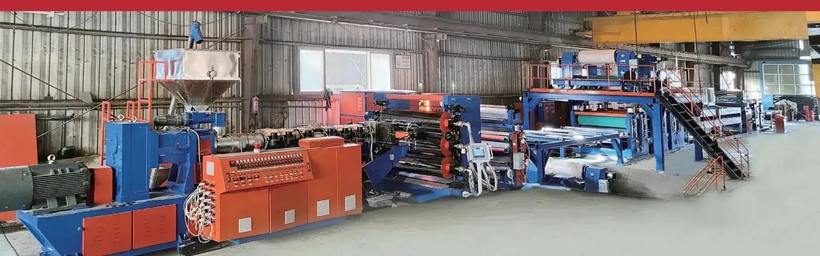
Multifunctional A2 B1 PE Aluminum Composite Panel Production Line manufactured by Zhangjiagang Hongyang Machinery Equipment Co., Ltd.
The line shown above integrates the extruder/lamination section (left), precision roll-press and bonding section (center), and the trimming and take-off conveyor (right). The compact arrangement minimizes material handling between stations, which directly improves bonding consistency and reduces the risk of interlaminar delamination -- a critical quality parameter for both B1-grade and A2-grade products destined for high-rise facade applications.
The isometric diagram below illustrates the internal layer stack of a standard aluminum composite sheet as produced by a multifunctional ACP production line. Understanding this cross-section is fundamental to appreciating why fire classification differs so significantly between PE, B1, and A2 grades.
The isometric cross-section above reveals the three-part structure common to all ACP products: a top surface coating (typically PVDF or PE paint), two thin aluminum skins, and the central core material. The core is the primary differentiator between grades: standard PE cores are lightweight and flexible but combustible, B1 mineral-filled cores contain fire retardant additives that slow ignition, and A2 inorganic cores -- composed largely of mineral hydroxides or calcium silicate -- release no significant combustible gas when exposed to flame. The 3-to-6-millimeter total thickness shown is standard for facade-grade products, with thicker sheets typically reserved for structural or high-impact applications. The coating layer, though only a few microns thick, determines both the color durability (PVDF coatings typically warrant 10 years of chalk resistance) and the initial combustibility contribution at the panel surface. Recognizing this layered structure helps procurement teams ask the right questions about skin gauge, core composition, and coating specification when sourcing from an ACP production line manufacturer.
Following major facade fire incidents in multiple countries during the 2010s, regulatory agencies worldwide have progressively tightened cladding combustibility requirements. The United Kingdom's Building Safety Act 2022 mandates A2-class cladding for all new residential buildings above 11 meters. Similar rules now apply in Germany (MBO Musterbauordnung, class A2 above 7 floors), the UAE (Dubai Civil Defence Circular No. 7/2013), and Australia (NCC 2022, Clause C2D8). These regulatory shifts have fundamentally reshaped ACP production economics: demand for A2 and B1 lines has grown substantially while standard PE capacity faces increasing restrictions in high-rise segments.
The horizontal bar chart above reflects estimated global ACP market composition by fire-resistance grade as of 2024. B1 fire-retardant grade holds the largest share at approximately 34%, driven by strong adoption in the Middle East, Southeast Asia, and Eastern Europe where building codes have been updated but full A2 mandates are not yet universal. A2-grade ACP has risen to roughly 28% share -- a dramatic increase from under 10% before 2017 -- as the UK, Germany, and Scandinavian markets enforced non-combustibility requirements. Standard PE-core ACP retains a 26% share, largely concentrated in signage, interior applications, and markets where facade height regulations do not yet require higher grades. Aluminum honeycomb and specialty composite products account for the remaining 12%, serving premium facade and aerospace-adjacent applications. This shift in demand distribution is the primary reason modern ACP equipment manufacturers have developed multifunctional lines capable of switching between PE, B1, and A2 production modes within a single platform.
A production line that claims to handle A2, B1, and PE grades simultaneously must meet several demanding technical requirements. Bonding strength between aluminum skin and core must consistently exceed 120 N/25 mm (peel strength per GB/T 17748 or EN 1396) regardless of core type. Line speed for PE grades typically runs 8--15 m/min; A2 roll-bonding may run slower at 4--8 m/min due to the higher lamination pressures required to achieve adequate adhesion to inorganic cores. Width capacity commonly ranges from 1,220 mm to 1,600 mm to accommodate international sheeting standards.
Core thickness control is another critical parameter: variations exceeding +-0.1 mm across the width of an A2-grade sheet produce visible surface waviness after installation, particularly on large-format panel systems. This requires both precision roll-gap sensors and real-time feedback control of the laminating press. Temperature uniformity across the width of the lamination nip must be held within +-3 degrees Celsius for PVDF-coated skins, since temperature gradients cause differential thermal expansion that results in bow or twist.
The column chart above compares the typical operating speed ranges for PE, B1, and A2 production modes on a multifunctional ACP line. Standard PE production achieves the highest speeds (8--15 m/min) because thermoplastic extrusion and bonding is a well-optimized continuous process that tolerates faster throughput. B1 fire-retardant grades run at 6--12 m/min, as the higher viscosity of mineral-filled PE compounds requires additional residence time in the lamination nip to ensure full adhesive bond formation. A2 non-combustible grades require the slowest speeds (4--8 m/min) because roll-bonding of rigid inorganic core slabs to aluminum skins demands sustained high contact pressure and careful temperature management to prevent delamination at the adhesive interface. Equipment suppliers who claim uniform speed across all three grades should be asked for documented bonding-strength test results at rated speed, as throughput and quality are directly linked in lamination engineering. A multifunctional line that genuinely handles all three grades is a significant engineering achievement, not a simple parameter change.
Selecting the right ACP grade involves balancing multiple performance dimensions simultaneously. The radar diagram below compares PE, B1, and A2 grades across six key attributes: fire safety, weight efficiency, flatness, processing ease, cost competitiveness, and regulatory compliance range. No single grade scores highest across all axes, which is why manufacturers who can produce all three grades with one line hold a structural competitive advantage.
The radar diagram clearly illustrates that PE-core ACP scores highest on weight efficiency, processing ease, and cost competitiveness -- which explains its continued dominance in interior, signage, and low-rise applications where fire regulations permit it. A2-grade ACP leads decisively on fire safety and regulatory compliance range, making it the preferred specification for any project governed by stringent non-combustibility codes. B1-grade products occupy the middle ground across most axes, offering a balance of improved fire performance over standard PE with better processability and lower cost compared to A2. Flatness scores are closely bunched between B1 and A2, reflecting the precision lamination requirements that both grades impose. The divergence on processing ease between PE (95%) and A2 (50%) explains why multifunctional production lines require more sophisticated controls when switching to A2 mode: slower speeds, higher lamination pressures, and tighter temperature tolerances all demand more advanced automation and sensor integration than a PE-only line would require.
The most significant shift in ACP production line engineering over the past decade has been the integration of digital monitoring and intelligent control systems. Early ACP lines relied on fixed-parameter PLC control; modern multifunctional lines incorporate real-time thickness gauging (using laser or beta-ray sensors), tension control across aluminum skin uncoil stations, closed-loop temperature regulation of lamination rolls, and automated quality rejection gates. These capabilities are not cosmetic upgrades -- they directly affect the consistency of A2-grade bonding, which is far less forgiving of parameter drift than PE production.
The line chart traces the rapid adoption of intelligent control systems in new ACP line installations from 2015 to 2025. Only 10% of new lines installed in 2015 featured closed-loop digital process monitoring; by 2023 that figure had risen to 72%, with the estimated 2025 penetration reaching 85%. This acceleration was driven by three converging forces: the increased quality requirements of A2-grade production, the tightening of international flatness and delamination standards (such as GB/T 17748 revision cycles), and the falling cost of industrial sensing and PLC hardware. Manufacturers investing in multifunctional lines today are almost universally specifying servo-tension control, laser thickness gauges, and recipe-based HMI systems that store grade-specific parameter sets, allowing rapid and repeatable changeovers between PE, B1, and A2 production modes. Lines still relying on manual parameter adjustment are at a growing quality disadvantage when producing A2 grades.
Zhangjiagang Hongyang Machinery Equipment Co., Ltd. is a national enterprise specializing in the R&D and manufacturing of intelligent equipment for metal composite materials, providing systematic solutions for the global construction materials industry. As a drafting unit of the standard for Non-Combustible Metal Composite Panels for Architectural Decoration and a standing council member of the Metal Branch of China Building Materials Federation, the company occupies a recognized position within the industry standards ecosystem.
The company's core product portfolio encompasses three major technological systems: fire-resistant aluminum composite panel production lines, aluminum honeycomb core machines and aluminum honeycomb core metal composite panel production lines, and multifunctional customized metal composite panel production lines. These systems collectively cover 12 categories of high-end production lines, including A2 and B1-grade fire-resistant material lines, 3D aluminum-core metal composite panel equipment, and the full range of aluminum honeycomb series production platforms.
The patent certificate below -- invention patent ZL 2016 1 0789112.9, granted June 2018 -- covers the company's multifunctional metal composite panel production line and manufacturing process, developed by inventors Zhu Peng and Zhu Liangcai. This patent reflects the proprietary engineering refinements that allow a single line to handle the range of core materials required for A2, B1, and PE production grades.
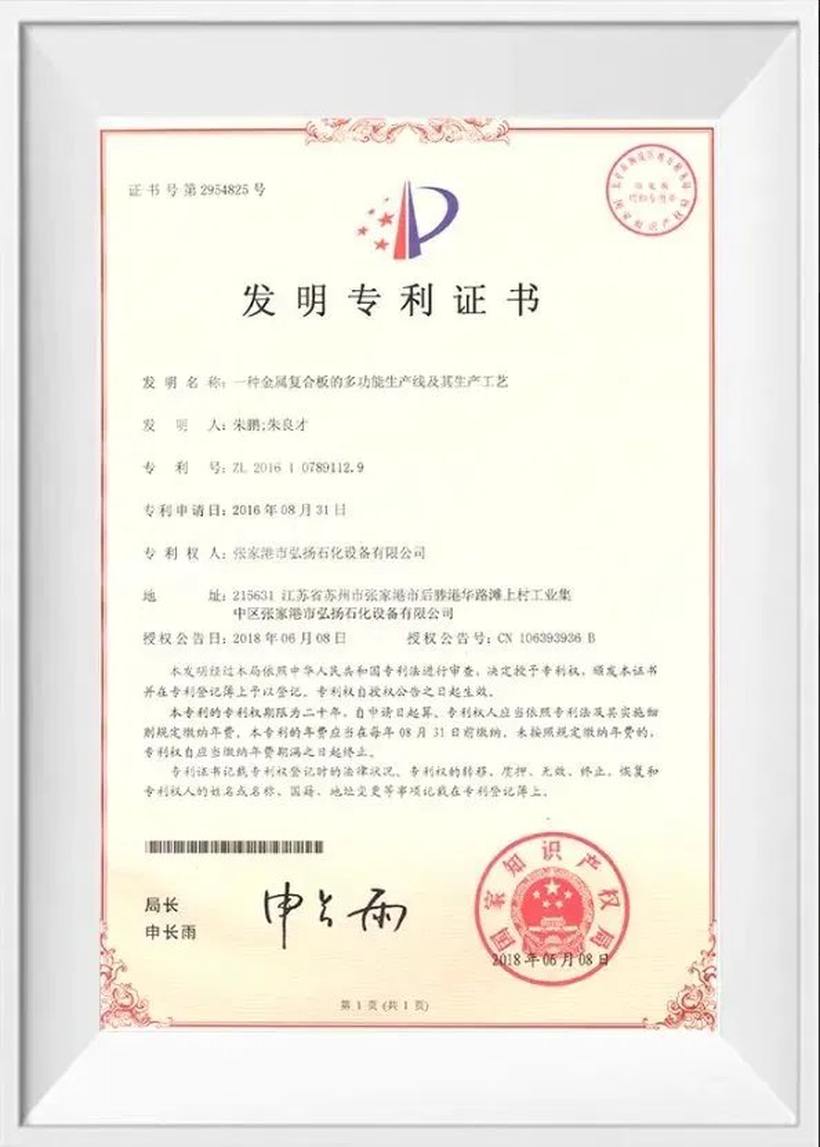
Invention Patent Certificate No. ZL 2016 1 0789112.9 -- Multifunctional Metal Composite Panel Production Line and Process, granted June 2018.
The sheet-versus-panel distinction is not merely academic -- it has direct procurement, logistics, and quality-control implications. When a fabrication shop purchases ACP sheet from a production line manufacturer or distributor, they receive flat slabs (commonly 1,220 mm x 2,440 mm or continuous roll widths up to 1,600 mm) that they will then route, fold, and frame using CNC routing machines and press brakes. The sheet's flatness tolerance, peel strength, and core homogeneity determine how precisely the fabricated panel corners can be formed and how well the surface will remain smooth after CNC routing removes approximately 2/3 of the core depth at return lines.
For curtain wall contractors specifying ACP panels, the finished panel geometry -- return depth, face dimensions, corner radius, fastener hole pattern -- must comply with project shop drawings. In this context, the panel's flatness after fabrication (post-routing bow) and its long-term dimensional stability under thermal cycling are the primary concerns. A2-grade sheets that use high-density mineral cores have lower thermal expansion coefficients than PE-core sheets (approximately 21 x 10^-6/K for PE-core vs. 17 x 10^-6/K for mineral A2), which means fabricated A2 panels exhibit less thermal movement in service -- a tangible benefit for large-panel facade systems with tight joint tolerances.
| Application | Product Form | Recommended Grade | Key Spec Priority |
|---|---|---|---|
| High-rise external facade (above 11 m) | Sheet for fabrication into panel | A2 non-combustible | Fire class, flatness, peel strength |
| Commercial exterior, mid-rise | Sheet or fabricated panel | B1 fire-retardant | Fire class, color consistency |
| Interior partition / ceiling | Sheet cut to size | PE or B1 | Surface flatness, weight |
| Signage and display | Sheet, light gauge | Standard PE | Printability, weight, cost |
| Transport vehicle body panel | Sheet, fabricated panel | PE or B1 | Weight, impact resistance |
Q1. Is ACP sheet the same as ACP panel?
No. ACP sheet refers to the raw composite material as produced on the production line -- flat, unprocessed, and ready for downstream fabrication. An ACP panel is a finished, installation-ready unit that has been cut, CNC-routed, folded at the returns, and fitted with mechanical fixing provisions. The sheet is the input material; the panel is the output of the fabrication process.
Q2. What does A2 grade mean for aluminum composite panels?
A2 refers to the Euroclass reaction-to-fire classification under EN 13501-1, indicating that the material is non-combustible and contributes negligible fuel load in a fire. A2-grade ACP achieves this by using an inorganic mineral core (such as aluminum hydroxide or calcium silicate compounds) rather than a combustible PE plastic core. Most European, UK, and GCC building regulations now mandate A2-class cladding for new buildings above specified heights.
Q3. Can a single production line manufacture both PE and A2 ACP?
Yes, with the right equipment design. A multifunctional ACP production line incorporates a switchable core-feeding system and adjustable lamination parameters, allowing operators to produce PE, B1, and A2 grades on the same line by changing the core material and adjusting speed, pressure, and temperature settings. This flexibility avoids the capital cost of multiple dedicated machines and is a key feature of modern line designs from specialized manufacturers.
Q4. Why is B1 grade different from A2 in practice?
B1 (limited combustibility, roughly equivalent to Euroclass B) uses a mineral-filled or halogen-free flame-retardant PE compound as the core. It slows ignition and reduces flame spread significantly compared to standard PE, but it does contain organic material and will eventually burn under sustained fire exposure. A2 cores contain little to no organic content and are classified as non-combustible. In practice, B1 is easier to process, lighter, and more cost-effective than A2, making it the preferred specification where codes allow limited-combustibility rather than full non-combustibility.
Q5. What should buyers check when sourcing an ACP production line for A2 grades?
Key evaluation criteria include: demonstrated peel strength test results for A2 core-to-skin bonds at rated production speed; line speed range for A2 mode (4--8 m/min is typical); availability of closed-loop thickness and tension control; supplier experience producing certified A2 material and willingness to provide sample test certificates; and after-sales support including parameter recipe assistance for A2 startup. Equipment patents and participation in industry standards drafting -- such as that held by Zhangjiagang Hongyang Machinery -- are also meaningful indicators of technical depth.
Q6. How does the ACP production line affect final panel flatness?
Flatness is determined primarily by lamination pressure uniformity, roll temperature consistency (within +-3 degrees C across width), core thickness accuracy, and cooling conveyor tension. Lines with closed-loop roll-gap control and servo-tension uncoilers achieve flatness tolerances of +-0.3 mm over 1,000 mm span, which meets the requirements of premium curtain wall systems. Inadequate pressure control is the most common source of bow and waviness in finished ACP sheet, and this becomes especially critical for A2-grade mineral cores, which are stiffer and less forgiving of pressure variation than PE compounds.

Tanshang Village Industrial Clusters, Ganghua Road,Jingang Town, Zhangjiagang City, Jiangsu Prvince, China

+86-18862679789
+86-15555592012
+86-13140831504

+86-0512-56720211

admin@evertopest.com
admin@acp-line.com
Copyright © Zhangjiagang Hongyang Machinery Equipment Co., Ltd. All Rights Reserved. Custom Composite Panel Production Line Manufacturers


 English
 Español
 русский
 عربى
عربى