


Get a Quote

+86-18862679789


admin@evertopest.com

Content
Cold roll forming is the most economical production method for long metal profiles with a constant cross-section. A coil of steel or aluminum strip is pulled through a sequence of shaped roller dies at room temperature, and each station bends the metal a little closer to the final profile until the full cross-section is complete. The line runs continuously, typically at 10 to 40 meters per minute, which is why roll forming is the first choice for roof sheets, wall panels, purlins, rack uprights, and automotive structural rails. Because every part is formed from the same continuous strip, dimensional consistency along the length is far better than what press braking can achieve when parts are produced segment by segment. For a plant manager evaluating capacity options, that combination of speed, consistency, and material efficiency makes cold roll forming the process to beat.
Consider a concrete example. A factory producing 200,000 meters of C-purlin per year can run a cold roll forming line for 3,000 to 4,000 operating hours with one operator, one uncoiler, one forming machine, and one automatic stacker. Producing the same output with press brakes would require four to six operators, repeated material handling, and welded or bolted joints between short segments. The material cost per kilogram is the same in both cases, but labor, floor space, setup time, and scrap rates push the comparison clearly in favor of roll forming at that volume.
For buyers planning a production line, the critical decision is not whether to use cold roll forming, but which machine configuration, roll tooling, and manufacturer will match their product family, material, and target cost. This guide explains the cold roll forming process step by step, compares machine types, reviews the advantages and limits of the technology, and sets out concrete criteria for selecting a cold roll forming machine manufacturer.
For high-volume profiles with a fixed cross-section, cold roll forming delivers the lowest unit cost, and the machine specification determines whether that cost is actually achieved.
Cold roll forming is a continuous bending operation in which a long metal strip is progressively shaped at room temperature by passing through pairs of rotating rolls with specially machined contours. The strip remains below its recrystallization temperature throughout the process, so the material does not become soft or scale as it does in hot forming. The grain structure is stretched and reoriented, and the bend zones harden, which increases the yield strength of the finished profile compared with the starting coil.
The term can be confused with cold rolling, and the two must be kept apart. Cold rolling is a flat reduction process in which thick strip passes through plain cylindrical rolls that squeeze the material into a thinner sheet. Cold roll forming is a bending process in which profiled rolls change the shape of the cross-section while the strip thickness stays essentially the same. In other words, cold rolling makes the stock thinner; cold roll forming makes the stock shaped. Both operations are performed cold, but they use completely different machines, tooling, and quality criteria.
The continuous and incremental nature of cold roll forming defines its capabilities. Forming is distributed over many stations, usually between 8 and 30, and each station performs a small angular bend of roughly 2 to 8 degrees, depending on material and profile depth. Because the bend is small at every step, the process can produce sharp corners, deep channels, and symmetrical or asymmetrical sections that would be difficult for a single press hit. The incremental bending also means that springback can be compensated by overbending at the final stations, which is why high-quality lines hold their geometry over long production runs.
Three characteristics separate cold roll forming from other metal shaping methods: the strip is continuous, the cross-section is constant, and the bending is incremental. Any profile that meets those three conditions is a candidate for the process. Profiles that change thickness or require closed shapes usually have to be produced by extrusion or by multistage press forming.
Cold roll forming strengthens the material in the bend zones, keeps the strip thickness unchanged, and produces constant profiles in unlimited length at line speeds up to 40 meters per minute.
A complete cold roll forming line is a synchronized sequence of stations. Each station has one job, and the quality of the final profile depends on the performance of every station. Understanding the order and the function of each unit helps a buyer specify the right line and diagnose problems later.
A coil of strip is mounted on a single-post or double-post uncoiler, which pays the material into the line under controlled tension. The strip then passes through a leveller, often a seven-roll or eleven-roll straightener, that removes the curvature left by the coil. The flatness of the entry strip is one of the most underrated variables in cold roll forming; a coil with heavy edge wave or center buckle will produce a profile that curves or twists even when the rolls are perfect.
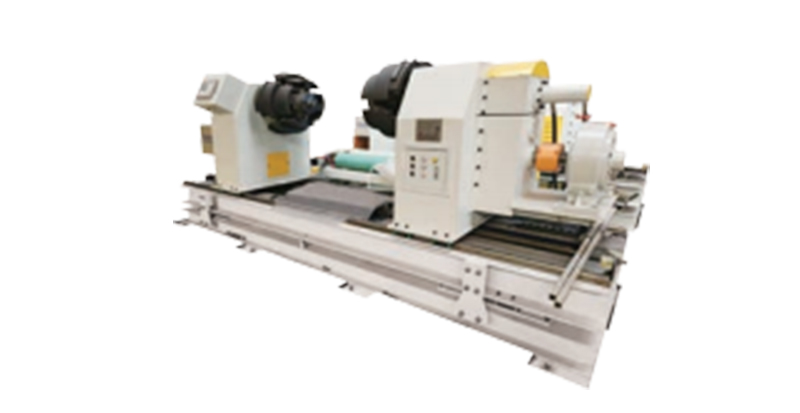 Hydraulic Uncoiler with Automatic Tension Control for Metal CoilsThis uncoiler maintains constant tension during unwinding, preventing stretching and edge wrinkling. It offers hydraulic coil loading, adjustable braking, and supports line speeds up to 100 m/min, making it a key entry component for heavy-duty forming lines.View Product →
An uncoiler for a heavy-duty line must match the coil weight, strip width, and required pay-off speed. Buyers should look for hydraulic expansion onto the coil bore, an adjustable braking system that maintains constant back tension, and a coil car or loading ramp that reduces changeover time.
Before the material enters the forming stations, inline presses punch holes, slots, and notches while the strip is still flat. Flat punching is faster and cheaper than punching a shaped profile, and hole position relative to the cross-section can be held to within 0.3 mm when the punching press is servo-synchronized with the line speed.
The heart of the line is the roll former. Each station carries two or more hardened rolls machined to the negative shape of the bend region. The first stations bend the outer edges, the middle stations close the web and side walls, and the final stations calibrate the entire cross-section. The rolls are normally made of high-carbon or alloy tool steel, hardened to 58 to 62 HRC, and are often chrome-plated when forming pre-painted or aluminum strip to protect the surface. The gap between the upper and lower rolls must be adjustable, because strip thickness tolerance and material hardness influence the gap requirement.
At the exit, a cut-off die cuts the continuous profile to the required length. Two families of cut-off systems exist. In a flying-die system, the shear carriage accelerates to the strip speed, cuts while moving, and returns, so production continues without stopping. In a stop-and-shear line, the feed stops briefly, the die cuts, and the line restarts. Flying-die systems are faster and produce cleaner ends on long profiles, while stop-and-shear lines are simpler, cheaper, and suitable for short blanks where length tolerance is critical.
Finished profiles fall onto an exit conveyor and are counted by a stacker that layers them into bundles. Automatic stackers classify profiles by length and stacking pattern and can feed wrapping and strapping stations. For large building panels, the stacker is often equipped with a sheet separator to prevent coated surfaces from scratching.
The number of forming stations, the roll material, and the type of cut-off dictate the profile depth, accuracy, and practical speed of the line; all three should be specified from the finished part drawing before the machine is quoted.
Cold roll forming machines are classified by their roll arrangement, the cut-off method, and the product family they are designed for. The simplest classification is by the number of forming stations and the width of the forming area, because those two numbers define the largest profile the machine can produce.
| Configuration | Typical profiles | Line speed | Best fit |
|---|---|---|---|
| Standard cut-to-length line | Corrugated roof sheet, wall cladding, floor decking | 20-40 m/min | Building envelopes, long runs |
| Flying-die line | Purlin, structural rail, guardrail, rack upright | 15-30 m/min | Long profiles with punched holes |
| Stop-and-shear line | Door frame, small HVAC profile, edge trim | 8-20 m/min | Short blanks, tight length tolerance |
| Double-layer line | Roof sheet plus gutter, or two similar profiles | 20-35 m/min per layer | Compact plants with two programs |
| Composite panel line | Aluminium composite panel, steel composite panel | 5-15 m/min | Fire-rated and sandwich panel products |
Each configuration carries its own trade-off. Standard cut-to-length lines offer the highest speed but are dedicated to a narrow range of profile widths. Flying-die lines combine punching, forming, and cutting in one process, which removes secondary drilling operations. Stop-and-shear lines are the most flexible for profile changes but sacrifice roughly half the line speed. Double-layer machines double the capital cost per floor meter but allow two product programs without a second building bay. Composite panel lines replace simple forming with a multi-stage laminating and edge-folding process, and they are the backbone of modern fire-rated building facades.
The second practical classification is by product family. Roof and wall sheet lines use wide, shallow rolls and high speeds. Purlin lines use deep, C-shaped or Z-shaped rolls with many stations. Door frame lines run small, thin profiles at moderate speed with precise length control. Rack upright lines integrate dozens of punching stations because storage racks are defined by their hole patterns. Floor decking lines use heavy strip and large roll diameters to handle the higher bending forces.
Before contacting a supplier, a buyer should have a list of target profiles with drawings, material grade, strip thickness, and planned batch sizes. A serious cold roll forming equipment manufacturer will use this input to recommend the configuration, the number of stations, and the auxiliary equipment.
The optimal cold roll forming line is defined by the product family and batch logic of the plant, and ordering a standard catalogue machine without profile analysis is the most common reason for line dissatisfaction.
Cold roll forming works with a wide range of metallic strip, but the mechanical properties of the material directly determine the roll design, the number of stations, and the achievable tolerance. High-strength steel requires more stations, larger roll diameters, and stronger machine frames because the springback is higher and the forming forces are larger. Aluminum, by contrast, is easy to bend but easy to scratch and requires chrome-plated rolls and clean strip surfaces.
| Material | Typical yield strength | Forming behavior | Notes for tooling |
|---|---|---|---|
| Low-carbon steel | 140-280 MPa | Excellent formability; predictable springback | Standard tool steel rolls; galvanized surfaces need scratch care |
| High-strength steel | 350-550 MPa | Stiffer springback; deep profiles need 20-plus stations | Hardened rolls; stronger main frame; lubrication recommended |
| Stainless steel | 200-310 MPa | Work-hardens quickly; surface can pick up roll marks | Chrome-plated or polished rolls; low friction coatings |
| Aluminium (3003, 5005, 5052) | 80-210 MPa | Very formable; low springback; soft surface | Chrome-plated rolls; dry or light-oil forming |
| Copper and brass | 50-250 MPa | Excellent; used for decorative profiles | Polished rolls; frequent cleaning of copper dust |
Tolerances follow a predictable pattern. A commercial-grade roof sheet line typically holds profile width to plus or minus 1 mm and cut length to plus or minus 2 mm on a 6 m sheet. A precision line with extra stations, hardened-lapped rolls, and servo-driven cut-off holds width to plus or minus 0.3 to 0.5 mm and length to plus or minus 1 mm. For small engineered profiles with a thickness under 2 mm, cross-sectional dimensions can be held within 0.1 mm when the roll set is ground as a matched set and the machine frame is rigid.
Geometric limits are equally important when reviewing a drawing for roll forming suitability:
For building materials, the most common cold roll formed family is the aluminium composite panel, where flat metal skins are bonded to a fire-retardant core and the edges are folded on the line. The panel then behaves as a flat, rigid construction board rather than as a bent profile. Although the forming step is limited, the continuous strip handling and tension control principles are identical to those of a roll forming line.
Material grade and tolerance class must be established before roll tooling is cut, because a change from mild steel to high-strength steel or from commercial to precision tolerance usually requires a new roll set.
| Selection factor | Cold roll forming | Press braking | Extrusion | Hot rolling |
|---|---|---|---|---|
| Typical production speed | 10-40 m/min | 1-3 m/min per operator | 5-15 m/min | 15-30 m/min |
| Tooling cost | High, multiple roll sets | Low to medium | Very high, heavy die sets | Very high, mill rolls |
| Bend consistency over 20 m length | Excellent | Poor, segment joints | Good | Good |
| Minimum economical batch size | 3,000-10,000 pieces | 100-1,000 pieces | 10,000+ pieces | 50,000+ pieces |
| Inline punching and notching | Yes | Separate operation | Limited | No |
| Material strengthening | Yes, via cold work | Local only | No | No |
| Surface finish | Good, film optional | Good | Moderate | Scale or brushed |
Interpreting the table, the decision logic becomes clear. If the part has a constant section, is longer than about 2 to 3 m, and the annual quantity exceeds 5,000 pieces, cold roll forming beats press braking on unit cost. If the quantity is below that range, the roll tooling cannot amortize itself, and press braking remains cheaper. Extrusion is competitive for aluminium profiles with complicated closed sections, but the extrusion die cost and lower line speed reduce the advantage for simple open shapes. Hot rolling remains attractive for heavy structural products where thickness reduction and forming happen together, but it is not a practical alternative for the thin sheet profile families that dominate building and automotive applications.
Experience shows that the largest hidden cost in cold roll forming is not the tooling but the changeover time between profiles. A plant running 15 profile changes per week loses several production hours to changeover if the machine is not equipped with quick-change cassette rolls. Buyers who expect a wide product mix should therefore budget for motorized roll adjustment and cassette tooling.
Cold roll forming wins when profiles are long, constant in cross-section, and produced in high annual volume; outside those conditions, alternative processes are often cheaper and more flexible.
Cold roll forming serves a wide range of industries, and the equipment specification differs considerably from one application to another. Construction is the largest consumer, followed by automotive, storage, HVAC, and energy. The chart below shows the indicative distribution of roll formed output by end-use industry, based on equipment supplier statistics and our export order data.
The distribution of cold roll formed output across end-use industries helps engineers and investors understand where the technology delivers the highest value. The figures below combine production volumes reported by equipment suppliers, trade association statistics, and export order records from China-based roll forming line projects. Construction dominates because roof profiles, wall panels, purlins, floor decking, and composite panels all rely on continuous bending. Automotive and storage racking contribute substantial volumes, while HVAC and energy applications are growing from a smaller base. Exact percentages shift from one region to another, but the ranking has remained stable for more than a decade.
| Construction and building | 45% | |
| Automotive | 20% | |
| Storage racking | 15% | |
| HVAC and ventilation | 12% | |
| Energy and other sectors | 8% |
Construction accounts for nearly half of global roll formed output, and the share is concentrated in a few high-volume profile families. Metal roof sheets and wall cladding are produced in continuous widths at line speeds of 20 to 40 meters per minute, which makes them ideal roll forming candidates. Purlin and structural profiles serve as load-bearing elements in steel buildings and account for a significant portion of the construction segment. Aluminium composite panels and fire-rated metal composite panels add a fast-growing sub-segment that uses continuous coil processing and edge-folding equipment. The automotive segment, at roughly 20 percent, relies on roll forming for crash-management rails, cross members, seat tracks, and window guide channels. Although automotive profiles are shorter than building profiles, they demand tighter tolerances and extensive end-piercing operations. Storage racking contributes about 15 percent of volume, driven by warehouses and logistics centers that need long, structurally stable uprights. Rack uprights feature dense hole patterns, which is why modern rack lines integrate servo-driven punching stations with the forming section. HVAC manufacturers use roll formed profiles for duct sections, reinforcement channels, and frame members, usually in light-gauge galvanized steel. The energy segment is growing fastest, with solar mounting rails consuming thousands of kilometers of roll formed profile every year. Each application imposes a different balance of tolerance, surface quality, and production volume, so the optimal machine configuration changes accordingly. Buyers planning new capacity should therefore define the end-use industry first and let the profile family, not the machine catalogue, drive the equipment specification.
In construction, cold roll forming produces the metal roof and wall sheets that cover industrial buildings, the purlins that support them, and the composite panels used in facades and interior partitions. Aluminium composite panels and fire-rated metal composite panels are manufactured on continuous lines that bond the aluminium skin to an A2 noncombustible or B1 flame-retardant core. The edge-turning and folding steps on such lines follow the same incremental roll forming logic as profile lines, which is why composite panel production shares much of the same equipment philosophy.
 Aluminum Composite Panel Production Line with Precision LaminationThis automated line continuously produces ACP sheets with customizable sizes, using multi-zone temperature-controlled hot pressing and precise tension control to ensure high-strength bonding of aluminum foil to core materials, suitable for architectural and signage applications.View Product →
An aluminium composite panel production line processes coil-fed aluminium skins, applies adhesive, laminates them to a mineral-filled core, and turns the panel edges to a precise rectangular geometry. The same principle extends to steel composite panels and truck trailer body panels, where the light weight and smooth surface of the sandwich panel reduce body weight while maintaining stiffness.
Automotive suppliers use cold roll forming for crash-management systems, roof rails, side impact beams, seat track, and window guide channels. These parts are shorter than building profiles, but they need tighter tolerances, edge quality, and end-piercing accuracy. High-strength steel grades in the 780 to 1,200 MPa range are increasingly common, and the line must be designed with additional stations and hardened rolls to manage springback.
Cold roll formed uprights and beams carry the load in pallet racks and high-bay warehouses. The profile cross-section, usually an open channel with return lips, is comparatively simple, but the hole pattern along the face is dense. Rack lines therefore run double-action punching stations synchronized with the feed, and the cut-off die must trim both ends cleanly.
Ductwork, profile fittings, and reinforcement channels in HVAC systems are made from light-gauge galvanized steel at high speeds. Batch sizes are medium, so quick-change roll sets are a common requirement. The fastest-growing application is solar mounting; aluminum and galvanized steel rails for PV modules are rolled in thousands of kilometers each year, with drilled or slotted holes that fit module clamps. Roll forming is the only economical way to produce that volume at low cost.
Each end-use industry imposes its own balance of speed, tolerance, hole pattern, and material grade, so the machine specification must be driven by the target industry data rather than by a generic machine list.
Selecting a cold roll forming machine is a capital equipment decision with consequences for years of operation. The cheapest quotation is rarely the most economical one when line speed, changeover, tooling life, and after-sales response are included in the calculation. The following process keeps the evaluation objective and practical.
Start by defining the line with hard numbers:
Cold roll forming is the right answer when...The part is longer than 2 m with a constant section; annual volume exceeds 5,000 to 20,000 pieces; tolerances need to be uniform across thousands of meters; inline punching replaces secondary operations; and floor space is available for a continuous line. |
Choose a different process when...The profile changes section along its length; batches are small and frequent; closed hollow sections are required; thickness varies; or the part has complex 3D bends that roll forming cannot produce. |
With the specification fixed, evaluate manufacturers on five points:
Look for documented proof: ISO 9001 covers the quality system; CE marks the electrical and safety design for the European market; export records show installation experience abroad. A supplier that has served clients in 45 countries and built lines for 14 of the world's top 20 metal composite panel producers will usually provide a far more detailed technical proposal than a supplier without such references.
For producers of fire-rated panels, the forming and laminating requirements are stricter than for standard panels. The A2 noncombustible metal composite panel production line combines mineral core handling, adhesive application, and skin forming in a single controlled process.
A2 Non-combustible Metal Composite Panel Production LineThis fully automated line replaces flammable organic cores with a Class A2 inorganic core, achieving fire resistance per EN 13501-1. It integrates mixing, forming, hot-pressing, and cutting at 1-3 m/min with intelligent temperature control for uniform curing.View Product →
During evaluation, ask each manufacturer for a preliminary layout drawing that shows the line footprint, the operator positions, the maintenance access points, and the electrical cabinet location. Compare the drawings side by side; a poorly planned line costs more in building space than the machine itself saved in price. Do not commit to a line without agreeing on a factory acceptance test. The test run should use your material, your profile drawing, and your length set points, ideally 500 to 1,000 linear meters of continuous production. The measured tolerance and surface quality at the acceptance test will predict the performance in your plant.
Shortlist only manufacturers that demonstrate reference lines for the exact product family you produce, and put the tooling steel grade, line speed, cut-off accuracy, and after-sales response time in writing.
Cold roll forming runs thousands of meters per shift, and small tooling problems compound quickly when multiplied by high volume. A preventive maintenance schedule based on running hours catches wear before it produces scrap. The table below summarizes a practical schedule for a typical line.
| Frequency | Check or action | Why it matters |
|---|---|---|
| Daily | Inspect strip alignment at entry; check hydraulic oil level; verify cut-off die condition | Prevents misaligned profiles and jagged cuts |
| Weekly | Lubricate roll bearings and drive chains; clean roll surfaces; check fasteners on the main frame | Reduces vibration and keeps surface finish uniform |
| Monthly | Measure roll wear with a depth gauge; calibrate line-speed encoder; inspect electrical cabinet air filters | Maintains dimensional tolerance and safe operation |
| Quarterly | Check roll bearings for backlash; test emergency-stop circuits; verify guarding interlocks | Safety circuits degrade silently and must be proven |
| Yearly | Re-level the machine base; evaluate roll set condition; replace worn tool steel sections | Extends line life and avoids production stoppages |
Common operational issues and their likely causes include: the finished profile curves to one side when roll pressure is uneven or one side of the roll gap is worn; wavy edges appear on the profile when the strip has an edge wave from the coil or the central rolls are not supporting the web correctly; cut lengths vary beyond tolerance when the encoder is slipping, the cut-off die clearance is wrong, or the feed rolls have worn grooves; surface scratches appear on painted strip when the rolls are dirty, the roll surface is unsuitable for coated material, or the strip is running too tight against a side guide; and tooling life is shorter than expected when the roll steel grade is too low for the material hardness or lubrication is not being applied.
Safety is non-negotiable on cold roll forming lines. The forming stations have high-speed rotating rolls and heavy strip under tension, and the cut-off die can exert several tons of force. A properly guarded line has fixed covers over the roll stations, interlocked access doors that stop the line when opened, two-hand controls or light curtains at the operator stations, and clearly marked emergency stop buttons at intervals along the line. Electrical cabinets must meet CE or the local standard the machine is intended for. Setup and tooling changes should be performed with the line locked out and the rolls manually turned only after the drive is disengaged.
Operators need structured training on feeding the strip, adjusting roll gaps, clearing jams, and recognizing early signs of tooling wear. Most serious injuries on roll forming lines occur during manual intervention inside the forming stations, so the rule "never reach inside with the drive engaged" must be physically enforced by the machine guarding, not just by a notice.
A maintenance schedule tied to running hours and a strictly enforced lockout procedure will prevent more than 80 percent of quality problems and virtually all serious injuries on a cold roll forming line.
Cold roll forming looks expensive at the purchase stage, especially when compared with a brake press of similar width. The economic logic lies in the unit cost at high volume, where tooling amortization and labor savings dominate the comparison.
Tooling cost scales with profile complexity more than with machine size. A simple corrugated roof sheet roll set with 12 stations may cost $15,000 to $30,000. A 24-station structural set for a high-strength purlin runs from $50,000 to $120,000 because the rolls are larger, harder, and more precisely ground. The machine itself, including uncoiler, former, cut-off, and stacker, typically accounts for 70 to 85 percent of the total investment.
The break-even point against press braking depends on three variables: labor cost per hour, cycle time per part in press braking, and the annual volume of the profile. As a rule of thumb, when a single profile exceeds 15,000 to 50,000 linear meters per year, the capital cost of a roll forming line is recovered within 18 to 36 months through labor and scrap savings.
Take a purlin manufacturer producing 240,000 meters per year. The current brake press operation uses four operators at a loaded labor cost of $12 per hour, which produces an annual labor bill of about $96,000 for this product line. Scrap runs at 4 percent against an annual material spend of $780,000, or roughly $31,000 lost to scrap. A roll forming line replaces three of the four operators, cuts scrap to 1 percent, and eliminates a secondary cutting operation. The combined saving is close to $90,000 per year. Against a total line investment of $320,000 including tooling, installation, and training, the payback period is about three and a half years under conservative assumptions.
Running costs should not be forgotten: electricity for drives and hydraulic pumps, grinding and replacement of rolls, lubrication, and maintenance labor. These typically amount to 5 to 10 percent of the annual operating cost. Spare roll sets for the most wear-prone stations are the single most useful insurance policy a plant can buy, because a waiting time of six to ten weeks for a replacement roll is a common cause of avoidable downtime.
When volume is sufficient, the return on a cold roll forming line comes from labor reduction, scrap savings, and elimination of secondary operations, not from a lower machine price.
These are the questions buyers and process engineers ask most often when evaluating cold roll forming equipment.
Cold roll forming is used to produce long metal profiles with a constant cross-section. Typical applications include roof sheets, wall cladding, purlins, floor decking, storage rack uprights, door frames, automotive structural rails, HVAC duct profiles, and solar mounting rails. The common thread is high volume: the process becomes economically attractive when thousands of meters of identical profile are needed per year.
Cold rolling is a thickness-reduction process: flat strip passes through plain rolls that squeeze it into a thinner sheet. Cold roll forming is a bending process: shaped rolls progressively bend the strip into a profile while thickness remains unchanged. The names are similar because both operate below the material's recrystallization temperature, but the machines, tooling, and products are completely different.
Commercial roof and wall sheet lines typically hold profile width to plus or minus 1 mm and cut length to plus or minus 2 mm on a 6 m sheet. Precision lines with additional stations and servo cut-off hold width to plus or minus 0.3 to 0.5 mm and can reach plus or minus 0.1 mm on small engineered profiles. Tolerance depends on material grade, profile depth, and the number of forming stations.
A machine with interchangeable roll sets can run different profiles within the same width and material family. Changeover takes 30 to 90 minutes with bolted rolls, or 10 to 20 minutes with cassette or quick-change systems. Profiles of completely different widths usually require a second machine or a double-layer line.
A well-designed roll set for galvanized steel typically lasts 2 to 5 million linear meters before re-grinding is needed. Stainless steel and pre-painted materials reduce tooling life because of higher hardness or abrasive coatings. Tool steel grade and hardness, plus consistent lubrication, are the main factors controlling tooling life.
Edge cracking is usually caused by an inside bend radius below the material limit, hardened edges left by poor coil slitting, or incorrect roll gap at the early stations. The solution starts with checking the slit edge condition, then verifying that the minimum radius is 0.5 to 1.0 times the material thickness for steel and 1.0 to 1.5 times for aluminum.
Match the machine to the profile family and the material, and the cold roll forming investment returns faster than almost any other metal forming equipment purchase.
Evaluating a cold roll forming line is easier when the machine builder offers both technical documentation and project execution capability. The resources below provide background on a key product family and on the installation and commissioning services that accompany our lines.
Aluminium composite panelsRead the technical background of aluminium composite panels, a major product family produced on continuous metal composite panel lines. This article explains the structure, properties, and common applications. What is aluminium composite panel |
Project servicesReview the project services we provide for production line buyers, including site planning, installation supervision, commissioning, remote support, and operator training. Project services |
If your company produces metal profiles for the building, transportation, storage, or energy sector, we can prepare a complete cold roll forming line proposal from your profile drawing, material grade, and annual output. The proposal includes the line configuration, the roll design, the auxiliary equipment list, a floor plan, and a budget delivery schedule. Contact us with your drawing and production targets, and our engineering team will respond with a technical and commercial offer.
Start the evaluation with the profile drawing and annual volume; a competent cold roll forming line manufacturer will return a line concept, budget, and delivery schedule within five working days.

Tanshang Village Industrial Clusters, Ganghua Road,Jingang Town, Zhangjiagang City, Jiangsu Prvince, China

+86-18862679789
+86-15555592012
+86-13140831504

+86-0512-56720211

admin@evertopest.com
admin@acp-line.com
Copyright © Zhangjiagang Hongyang Machinery Equipment Co., Ltd. All Rights Reserved. Custom Composite Panel Production Line Manufacturers


 English
 Español
 русский
 عربى
عربى